
Today’s post is from Aylin Yazici’s Games & Takes, a newsletter dedicated to mobile games and monetization. She has graciously allowed us to republish it here.
I first became aware of Aylin on LinkedIn, where she was posting these wonderful breakdowns of popular mobile games as an Analyst for Liquid and Grit. Everything from sticky mechanics, liveops features and monetization strategies. She’s also an editor for Deconstructor of Fun and manages BD and Partnerships for Ciao Games, so you know she’s worth listening to.
AI Has Already Won Inside Mobile Studios
If you spend enough time on LinkedIn, you could easily believe that AI is about to reinvent game development. Every week there’s another post about AI-generated characters, autonomous game designers, or one-person studios building the next billion-dollar hit.
Then you look at what successful mobile studios are actually doing. The picture is much less dramatic and, in my opinion, much more interesting.
Over the past few weeks, I went through dozens of reports, studio interviews, case studies from companies like Supercell, King, Scopely, Unity & more. I also did something else, which I’ll get to at the end: I spent the last two months building a mobile game with AI myself, as someone who can’t code. So this isn’t just a reading list. Some of these conclusions I tested with my own hands. What I expected to find was evidence that AI was beginning to change how successful games are designed.
AI isn’t changing what successful studios build. It’s changing how efficiently they build it. And I don’t think most of the industry has understood what that actually means yet.
AI has quietly become infrastructure
Two years ago, the industry debated whether AI would become part of game development. Today, that debate is largely over.
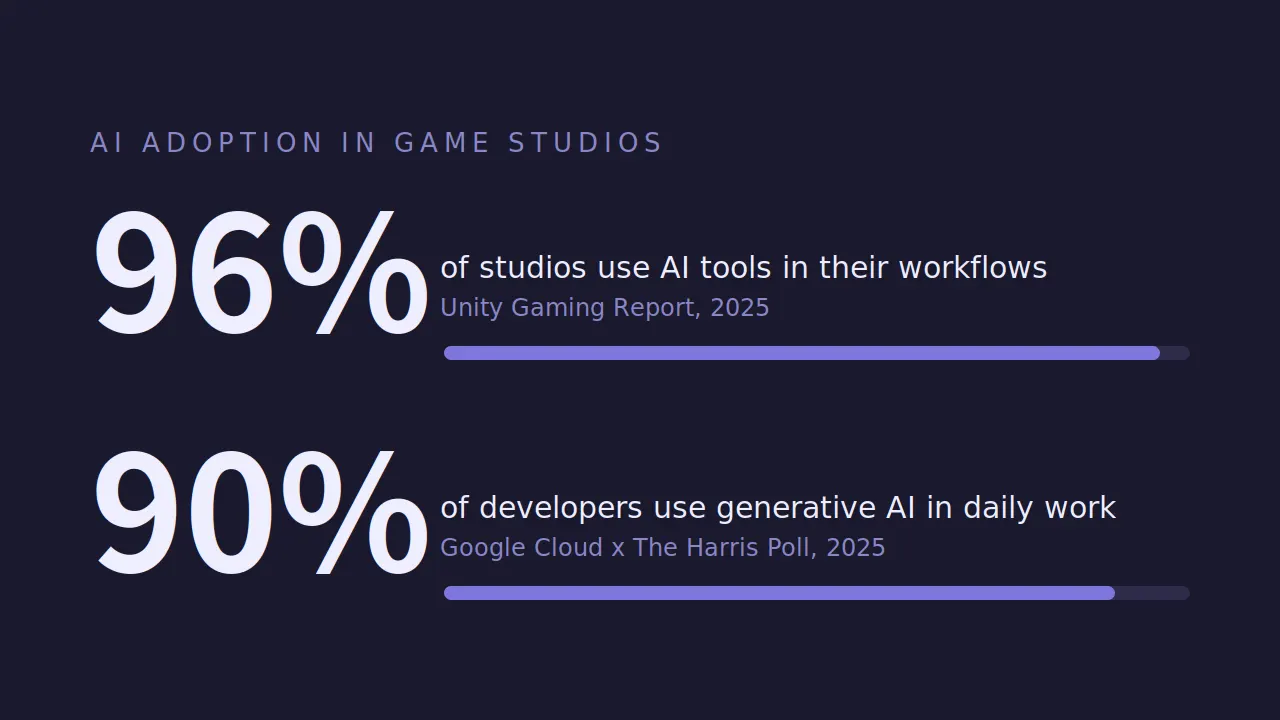
- Unity reports that 96% of studios surveyed are already using AI somewhere in their workflows.
- Google Cloud found that 90% of developers now use generative AI in at least part of their daily work.
Those aren’t experimental numbers anymore, they suggest AI is becoming standard infrastructure rather than a competitive advantage.
What’s interesting is where the adoption happens. Almost never where players can see it. Studios aren’t asking AI to invent the next Clash Royale. They’re asking it to generate fifty creative variations, summarize thousands of player reviews, automate regression testing, and write faster codes. This is exactly right, and the studios doing it quietly are smarter than the ones doing keynotes about it.
That may sound less exciting than AI-generated games, but it’s also where nearly all of the measurable business value currently exists.
The biggest winner is production
One pattern appeared repeatedly across almost every studio case study. The companies seeing the largest gains weren’t necessarily creating better games. They were creating more opportunities to discover better games.
MAG Interactive may be my favorite example. Historically, the company tested around five or six new game concepts per year. Their CEO now believes AI could allow them to test five or six concepts every quarter without significantly increasing team size. It fundamentally changes how many bets the studio can place. Same people, four times the shots on goal.
The efficiency gains reported elsewhere are just as striking:
| Studio | Reported gain |
|---|---|
| TapNation | ~90% faster asset creation, 30–40% faster coding |
| Games United | +240% production productivity (Layer AI case study) |
| LBC Studios | Character workflow cut from ~320 hours to ~40 hours |

In April 2024, King was publicly talking about how it balances human and AI-powered design in Candy Crush. In July 2025, it cut around 200 roles as part of Microsoft’s wider Xbox layoffs. The official line to staff was about removing layers and merging overspecialized crafts. But multiple insiders told mobilegamer.biz something more uncomfortable: level designers and copywriters were effectively being replaced by the AI tools they had spent months building and training. “Most of level design has been wiped, which is crazy since they’ve spent months building tools to craft levels quicker,” one staffer said.
User Acquisition is where AI already pays for itself
If development is becoming faster, user acquisition is becoming almost unrecognizable.
AppsFlyer reports that leading mobile advertisers now produce roughly 2,400–2,600 creative variations every quarter, and Century Games reportedly pushed that concept even further during Kingshot, producing as many as 3,000 AI-assisted creatives per day while scaling one of the fastest-growing mobile launches of 2025.
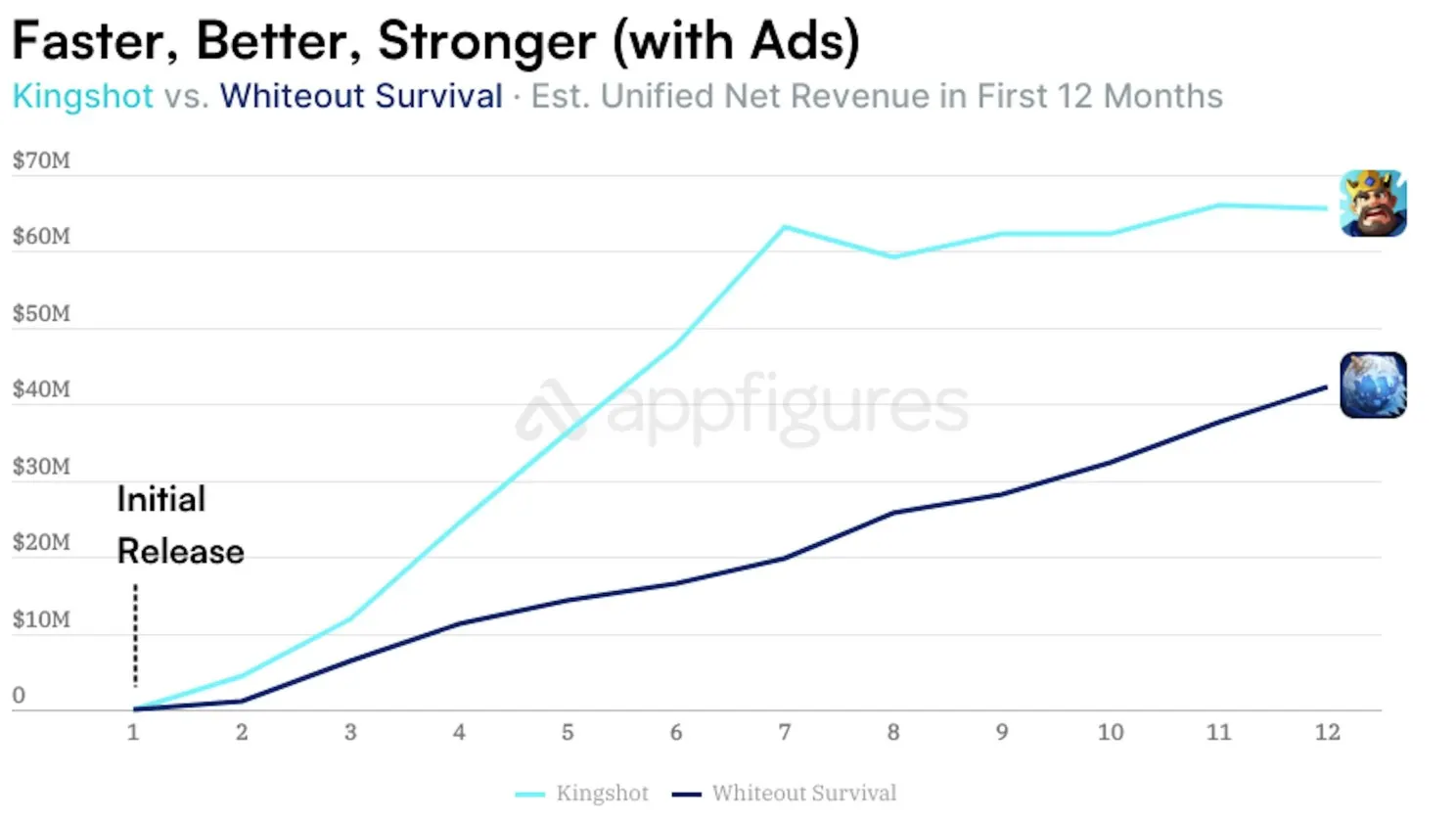
The production cycle with AI is crazy, but of course, one thing comes to mind when I see those numbers: what’s the lift of creating that many AI creatives? We know AI makes almost every production process faster now, but if that next winner creative isn’t coming from that 3000 batch, then what’s the point?
This is the part of the AI story I think the industry has backwards. UA was always the natural home for AI because it’s a pure optimization problem. Clear objective, instant feedback, measurable success. AI eats problems like that. Ironically, however, AI has also created a new bottleneck.
Creative production is no longer infrequent. Player attention is. The challenge has shifted from creating hundreds of ads to identifying which handful actually deserve a spend. Everyone’s paying for generation, but are they also paying for evaluation?
So… has AI made games better?
This was the question I kept coming back to while reading all of these reports. The answer, surprisingly, is that we don’t really have evidence that it has.
We have plenty of evidence that AI makes studios more efficient. We have evidence that teams prototype faster, ship LiveOps content more frequently, analyze data more effectively, and optimize acquisition campaigns more efficiently. But there is very little public evidence showing that AI consistently improves D30 retention, creates stronger core loops, or increases the probability of launching a hit.
Even former Voodoo executives, discussing AI-assisted development, described the primary benefit as reducing development cycles from roughly 14 days to 10 days, while arguing that “game feeling” remains fundamentally human.
I think this is the biggest misconception about AI right now. People assume productivity compounds into quality, it doesn’t. Productivity compounds into volume. Quality still comes from the same place it always did, and there’s no API for it.
The industry is adopting AI faster than it is trusting it
- GDC’s 2026 State of the Industry survey found that 52% of game developers believe generative AI is having a negative impact on the industry, even though AI adoption continues to rise.
- Quantic Foundry reported that 85% of surveyed players hold negative attitudes toward generative AI in games, particularly when AI is used for artwork, dialogue or music rather than invisible backend systems.
Put those together and you get the strangest dynamic in the industry right now: studios rely on AI more every quarter and talk about it less. The more invisible the AI, the more comfortable everyone is. I think it’s the market correctly pricing where AI adds value and where it destroys it. Players aren’t rejecting AI, they’re rejecting visible shortcuts which is honestly fair.
So I decided to stop reading about AI and actually build with it
There’s something I’ve only shared with a handful of people.
Over the last couple of months I’ve been building my own mobile game almost entirely with AI. I’m not a programmer. I have no engineering background. Before AI, building a game alone wasn’t something I’d have seriously considered. Which is exactly why I had to try it. I wanted to know where AI actually helps and where the LinkedIn posts are lying.
One thing mattered from day one: it couldn’t feel like an “AI game.” You know the ones. After a while you recognize the patterns. Generic art, UX with no intention behind it, gameplay that feels assembled rather than designed. I wasn’t interested in proving AI could generate a game. I wanted to see whether it could help me build one.
So I used AI for the things I genuinely couldn’t do. It wrote code I’d never be able to write, debugged problems I couldn’t diagnose, explained concepts I didn’t know, and cleared a hundred small blockers that would normally end a non-technical person’s project. The product decisions stayed mine. The mechanic, the progression, the visual direction, the pacing, every one of the countless small calls that make a game feel coherent.
Because I started right in the middle of the current AI explosion, my workflow never sat still. Every few weeks brought a better coding model, a new MCP, a more capable IDE. I switched agents multiple times, rebuilt parts of my setup, and honestly spent more time tuning the workflow than building the game. Two months in, and I’m thinking, “if I started over today with what I now know, I’d reach the same point in under a month”. A third game, faster still.
That’s the real story of AI for individuals, and it mirrors what’s happening inside studios. AI didn’t build my game. It compressed the learning curve so hard that someone like me could climb it at all. It didn’t replace my thinking. It multiplied what I was already capable of.
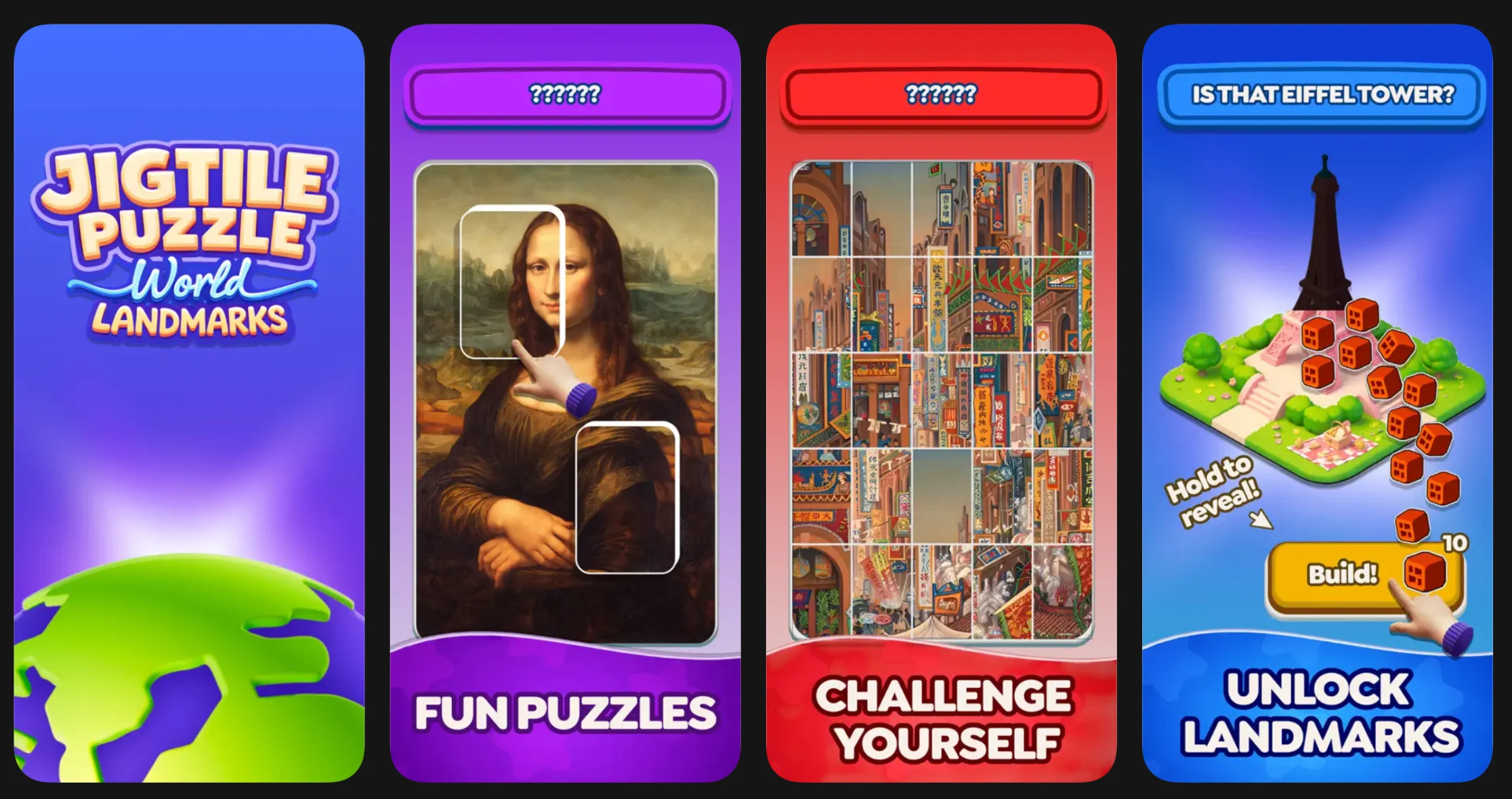
(If you’re curious, the project is still in a very early stage, but you can take a look here: Jigtile — Sort World Landmarks)
My biggest takeaway
For years, execution was expensive. Building assets, writing code, testing levels, creating marketing materials, and shipping LiveOps content all required significant time and manpower. AI is steadily reducing those costs.
When execution becomes cheaper, something else becomes more valuable. Judgment, taste, product intuition, understanding player psychology, knowing which prototype deserves another month of development, understanding why one creative resonates while another doesn’t.
AI can help generate options. It still doesn’t reliably tell us which option players will love. And that, to me, is why I don’t think the studios that win over the next years will simply be the ones using the most AI. The winners will be the ones whose judgment can keep up with their new output.
You can find Aylin Yazici on LinkedIn, and read more of her work in the Games & Takes newsletter.