
Vibecode.game — Industry Analysis
In September 2024, Andreessen Horowitz published an essay arguing that generative AI would do to interactive entertainment what CGI did to film — and that the company sitting at the top of that wave could be the next Pixar. They named Rosebud AI and Astrocade as early examples of what that future looked like. They called it the citizen creator moment.
That essay is now twenty months old. Enough has happened since then to audit it.
Not to celebrate it. Not to debunk it. To actually check whether the evidence is moving in the direction a16z said it would — and where it isn’t.
What the Thesis Actually Said
The Pixar argument is worth being precise about, because it’s doing more work than it first appears.
A16z wasn’t just saying generative AI would make game creation easier. They were saying a foundational technology shift was underway, and that the companies built natively on top of it — not retrofitting it into existing workflows — would define an entirely new category of creative output. Pixar didn’t use 3D graphics to make slightly better animated films. They built the creative language of 3D storytelling from scratch, and everything that followed was downstream of what they figured out in the 1980s and 1990s.
The a16z bet is that someone will do that with generative AI. That there will be a company, or a small number of companies, that define what AI-native game creation looks like at the cultural level — not just the technical one. Their term for the people who would drive this was “citizen creators”: people who have ideas and can now execute them without the years of technical training that used to be the price of admission.
Rosebud AI, in this framing, wasn’t just a tool. It was evidence that the citizen creator class was real and growing.
Where the Evidence Supports It
The citizen creator thesis has one very strong data point: the games that won in 2025 were made by smaller and smaller teams.
Schedule I — $151 million on Steam, 414,000 concurrent players, more than GTA V at the same moment — was made by one Australian. PEAK — over 10 million copies sold — started as a game jam. Lethal Company, which established the friendslop formula that both those games benefited from, was made by a single developer who used to make Roblox games. The direction of travel is clear. The team size required to make a culturally significant game keeps shrinking. That’s the citizen creator thesis playing out in the market, even without AI game creation platforms as the mechanism.
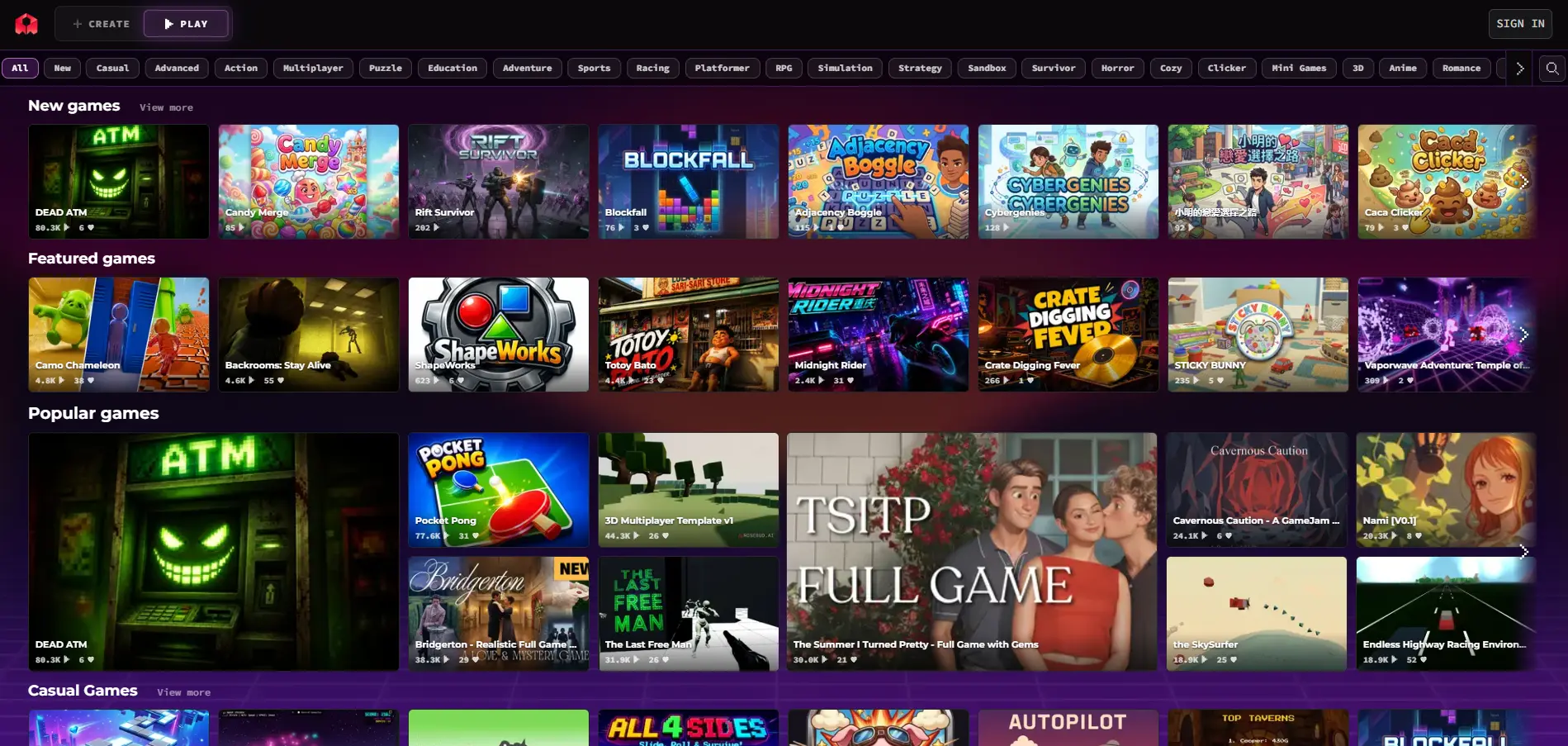
Rosebud itself has grown. The platform now hosts over 2.3 million community-created games. The product has matured: multifile architecture for complex projects, FlutterFlow integration for publishing to iOS and Android, multiplayer via InstantDB, commercial rights on paid plans, and a tipping system that lets creators earn from players directly. Gen Z and Generation Alpha make up roughly 65% of active users. The fastest-growing segment is the 22-35 “side hustle creator” — people using AI asset generation to prototype monetizable games, not just hobbyists making things for fun.
The citizen creator class exists. A16z was right about that.
Where the Evidence Complicates It
Here’s what the thesis didn’t account for: making a game is now easy. Getting anyone to play it is not.
Rosebud has 2.3 million games. The overwhelming majority of them are played almost exclusively within the Rosebud platform, by other Rosebud creators. The discovery problem — the gap between “I made a thing” and “people found the thing and kept playing it” — has not been solved by AI creation tools. If anything, it’s gotten worse. The same forces that made creation easier have flooded every distribution channel with more content than any discovery algorithm can surface effectively.
This is the Pixar analogy’s blind spot. Pixar didn’t just have generative technology. They had John Lasseter and Pete Docter and a story trust that operated with a specific creative philosophy about what made a film emotionally true. The tools were necessary but not sufficient. What made Pixar iconic was taste, applied at every stage of production, by people who were willing to tear things apart and rebuild them until they were right.
AI creation tools give you the tools. They don’t give you the taste. And they don’t solve distribution. The citizen creator class is real, but most of what it’s producing is circulating inside creator communities rather than breaking into mainstream culture. That gap — between prolific and culturally significant — is the thesis’s open question.
The Speedrun Tell
The most honest signal about where a16z’s thesis actually stands isn’t in their published essays. It’s in their Speedrun accelerator data.
Speedrun was born from the a16z Games Fund in 2023. The name is gaming terminology — completing a game as fast as possible. In SR001, the first cohort, 56% of the 25 companies were game studios. Demo Day ran during GDC. The mentor list featured Mark Pincus and Sean Rad. The DNA was entertainment.
Open the SR006 roster — the sixth cohort, completed in spring 2026 — and the picture is unrecognizable. 87% of the 60 companies carry an AI tag. More than half are B2B. A third put revenue numbers directly in their one-sentence descriptions. Game studios: one. Out of sixty.
Three years. Six cohorts. Gaming went from protagonist to footnote.
This isn’t a betrayal of the original thesis. It’s a rational response to where the evidence went. When the a16z Games Fund launched Speedrun, building an AI product required 10 to 30 engineers and the technology itself was the barrier. By SR006, two or three people could ship a complete B2B SaaS product in weeks using tools like Claude Code. The build barrier collapsed — and when it did, “can you sell” became the only question that mattered. Revenue proof replaced team size as the selection criterion. The citizen creator thesis ran into the same reality: when everyone can build, the bottleneck moves downstream.
A16z didn’t abandon the games thesis in their public writing. They quietly redirected their early-stage capital toward sectors where citizen creators were generating revenue — not just games. That’s a meaningful distinction.
What They’ve Actually Backed
The a16z direct investments in AI game creation are real but concentrated.
- Rosebud AI is the flagship.
- Series AI, which is building an end-to-end platform for AI game creation and licensing major IP, is the more ambitious infrastructure bet.
- Kaedim, which built AI-powered 3D art outsourcing, addresses the asset bottleneck that professional studios face when integrating AI into existing pipelines.
- Speedrun’s game-adjacent investments include Hedra, which focuses on content creation, and various companies working in XR and interactive entertainment.
Over $180 million has been deployed through Speedrun across more than 150 startups. The total a16z investment across gaming and entertainment is substantially larger. But the portfolio tells a more nuanced story than the essays suggest: a16z is betting on the infrastructure and tooling layer more than the consumer platform layer. They invested in Rosebud as a citizen creator platform, but their broader pattern looks more like “what tools will the next generation of creators use” than “which platform will host the breakout games.”
That’s actually a smarter bet. Infrastructure tends to win regardless of which specific games or creators break through. The tools matter whether or not any particular Rosebud game ever goes viral.
Benchmark and Supercell as Corroboration
A16z’s thesis doesn’t stand alone. Two other investors have made independent bets that point in the same direction, from completely different angles.
Benchmark — whose portfolio is built on eBay, Uber, Instagram, Twitter, and Snapchat — quietly added their name to HypeHype’s website without a press release. Benchmark doesn’t invest in categories. They invest in platforms with network effects, where value compounds as more participants join. HypeHype’s remix mechanic — where every game becomes a building block for the next creator, with revenue attribution flowing back to the original — is that kind of system. Benchmark’s presence says: there is a structural platform play here, at the creator economy layer, that could become infrastructure.
Supercell — €3 billion in revenue in 2024, majority owner of HypeHype since 2016 — is the operator bet. A decade-long relationship with a team that built Badland and Rumble Stars, now pivoting hard into AI-native creation from a foundation of real mobile game credibility. Supercell’s signal is the most specific: we know this team, we’ve watched them for a decade, and we believe they can build the mobile-native version of what a16z is describing.
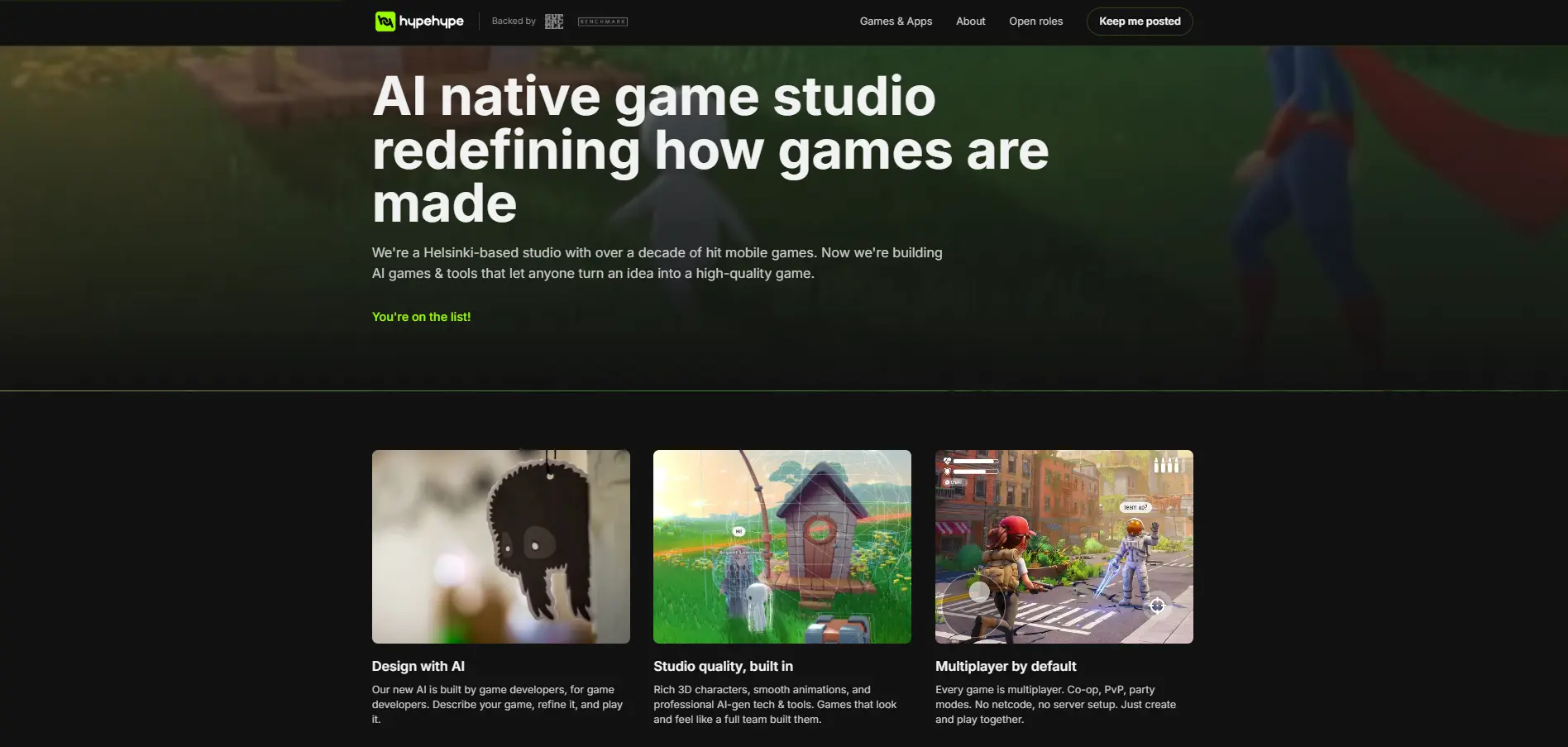
Three investors. Three frameworks. The same conclusion. When that happens, the category question is settled. This market is real.
HypeHype’s social channels have been quiet for at least a month, and their release notes page no longer renders content publicly. The most recent confirmed activity is CEO Johannes Vuorinen at a Supercell hackathon in March 2026 and an app update in January 2026. No shutdown announcement, no layoff reports. But the silence is worth noting — the platform may be in a head-down rebuild around its Live Gaming pivot, or it may be experiencing the same friction that a16z’s Speedrun data suggests: building was the easy part.
The Question the Thesis Still Hasn’t Answered
A16z was right that generative AI would change who could make games. The citizen creator class is real, it’s growing, and the data from Rosebud’s 2.3 million games confirms it exists at meaningful scale.
They were right that the team size required to make a culturally significant game would keep shrinking. Schedule I, PEAK, and Lethal Company proved that in 2023 through 2025, even without AI creation platforms as the primary mechanism.
What the thesis hasn’t yet answered — and what the Speedrun pivot quietly acknowledges — is the distribution problem. Creation tools solve the supply side. Nobody has solved the demand side. Nobody has built the mechanism that reliably connects citizen creator output to the audience it deserves.
Crayon AI’s Poki and CrazyGames distribution angle is the most interesting unsolved move in the space precisely because it’s the only platform explicitly attacking that problem rather than assuming it away. But Crayon is still pre-launch. The problem remains open.
The Pixar analogy works on the technology side. The part a16z left out is that Pixar also had Steve Jobs, who understood distribution and positioned the company so that Disney had to buy them. The citizen creator moment needs its distribution answer. Until that exists, the thesis is half right — which, in venture capital terms, may be enough.
The capital is in position. The tools exist. The creators are building.
The games that break into mainstream culture from this infrastructure are still coming. When they do, a16z will have been right. The more interesting question is whether the platforms they backed will be the ones that catch that moment — or whether it happens somewhere else entirely.
Sources
- The Next Generation Pixar: How AI will Merge Film & Games — Andreessen Horowitz (Sep 2024)
- The Generative AI Revolution will Enable Anyone to Create Games — Andreessen Horowitz (Apr 2024)
- GAMES FUND ONE: Building the Future of Games — Andreessen Horowitz
- Investing in Series AI — Andreessen Horowitz (Sep 2023)
- Investing in Kaedim — Andreessen Horowitz (Mar 2024)
- Speedrun’s Pivot Is the Playbook: What a16z’s Accelerator Reveals About the AI Opportunity Map — Gen AI Assembling (Apr 2026)
- Why a16z’s ‘Speedrun’ accelerator is playing a new game — Fortune (Apr 2025)
- Two Kings, One Throne — Is it YC vs A16Z in the arms race for AI startups? — Lobster Cap (Nov 2025)
- Speedrun — a16z — Andreessen Horowitz
- Rosebud AI — 2026 Review, Pricing & Alternatives — AI Gear Base (Apr 2026)
- Rosebud AI customer demographics and target market — Business Model Canvas Template (Mar 2026)
- Benchmark (venture capital firm) — Wikipedia
- Supercell (company) — Wikipedia
- HypeHype — Johannes Vuorinen LinkedIn — LinkedIn (Mar 2026)