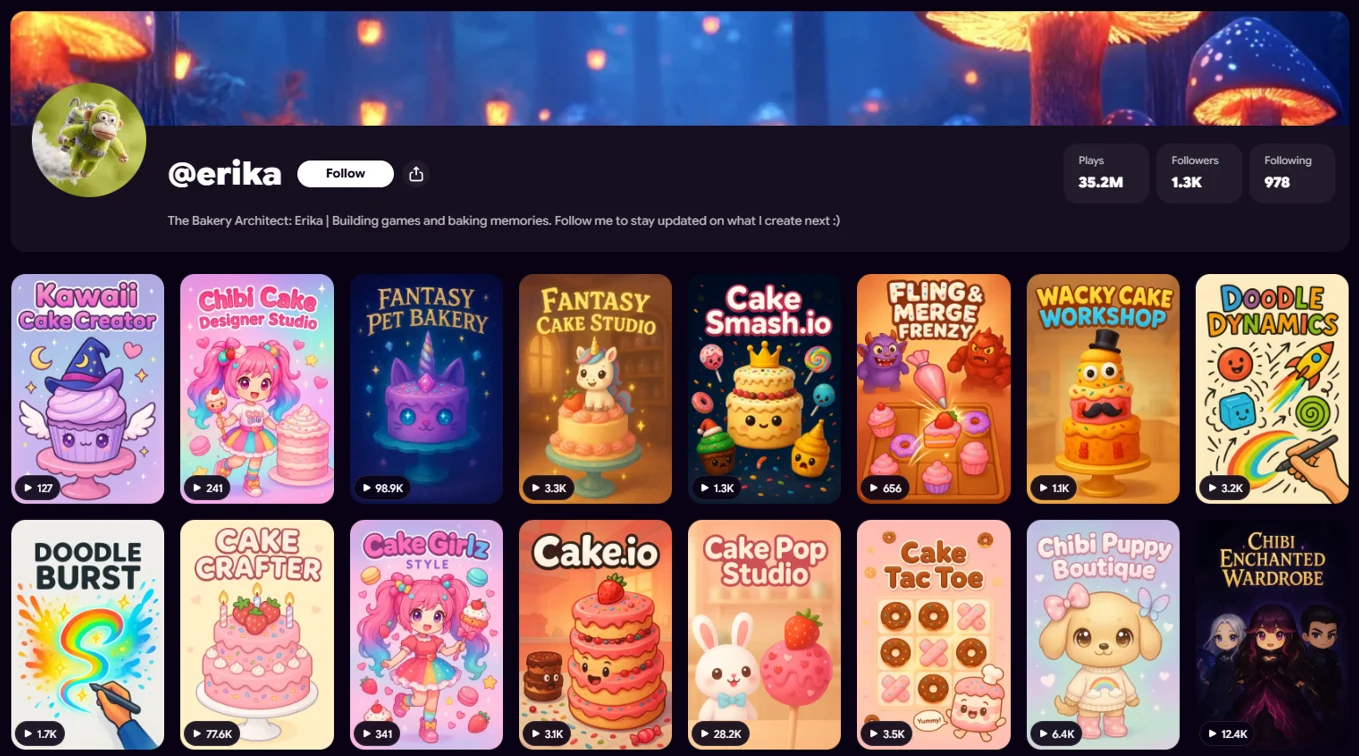
Erika Zucker is a Brooklyn-based creative with a background in animation, digital video, and social media production, most recently as a senior social media specialist, where she built out content strategy and video work for brand clients. A Communication Design graduate of City Tech, CUNY, she came to game development sideways: through a stint building mini-apps at a content platform, which led her to Astrocade, an AI “wish-to-game” platform where users describe the game they want and watch it get built in real time.
In her time on Astrocade, Zucker has published more than 600 games, become one of its brand ambassadors, and turned what started as curiosity into a steady, meaningful income. Titles like “Frosting Frenzy” have crossed 2 million plays, and by her own count it took her seven months to reach 30 million plays total. We sat down with her to talk about how she got started, how her workflow has evolved, and what she’d tell someone opening the platform for the first time.
| At a glance | |
|---|---|
| Platform | Astrocade — AI “wish-to-game” creation |
| Games published | 600+ |
| Total plays | 30 million in seven months |
| Breakout title | ”Frosting Frenzy” — 2M+ plays |
| Typical earnings | $1,000–$3,000 per month |
| Main workstation | Her phone |
Finding her way in
Vibecode.game: What first got you into game development? I know your background was more in marketing and social content.
Erika: I actually did animation in college, and I really enjoyed that. Before Astrocade, I was working as a mini-app developer, making small apps and games. While I was there I did some research on people who worked at other companies in the space, and I came across someone at Astrocade. I checked it out. I didn’t know how to make games at all. I brought in something I’d made elsewhere to see how it would translate, they gave me advanced model access, I became an ambassador, and I started going to their office hours and Astro Academy courses. That’s really how I improved. I just enjoyed doing it.
Learning the ropes
Vibecode.game: Many of these platforms just drop you into the deep end and present you with an open field; “What would you like to build?” That can be intimidating for some. Is there a more gradual descent into becoming a game creator? You mentioned the Astro Academy.
Erika: Definitely. It started as a season-by-season course: we went through it lesson by lesson, made our first games, and got better from there. I’ve been through it two or three times. It’s especially useful for the practical stuff: how to lazy-load your game, how to build in-game tutorials, why you shouldn’t overload your screen with text or menus, how to optimize performance. They’ve since made it accessible to everyone through the website, not just people going through it live.
Vibecode.game: Walk me through what that actually looks like in practice, from an empty prompt box to something playable.
Erika: Start in Astro Academy if you have access to it. If you don’t know what kind of game you want to make, you can literally ask the AI to inspire you, or describe a vague idea, say “a fantasy world game,” and it’ll suggest directions. Use the wish builder, keep your prompts small rather than one long request, and lean on the community: join the Discord, ask questions, look at what’s performing well, and just build something simple to start. Before you publish, test it on desktop, Android, and iPhone, because something that works fine on one device can break on another. Get a friend to actually play it, not just look at it.
Vibecode.game: And once something’s built, is publishing open to everyone? Is there an approval process?
Erika: Anyone can publish. If you’re under 18, a family member would need to approve your account so you can earn money. Every game goes through a review process, usually one to four days, and once it’s live it sits in a community testing window for about 300 views before it can earn a permanent spot on the site or become Featured or Trending if it meets the qualifications. You can publish up to two games a day and push five updates a day if you need to fix something.
The daily grind
Vibecode.game: Now that you’ve had all this experience developing 600 games, how has your workflow changed since you started?
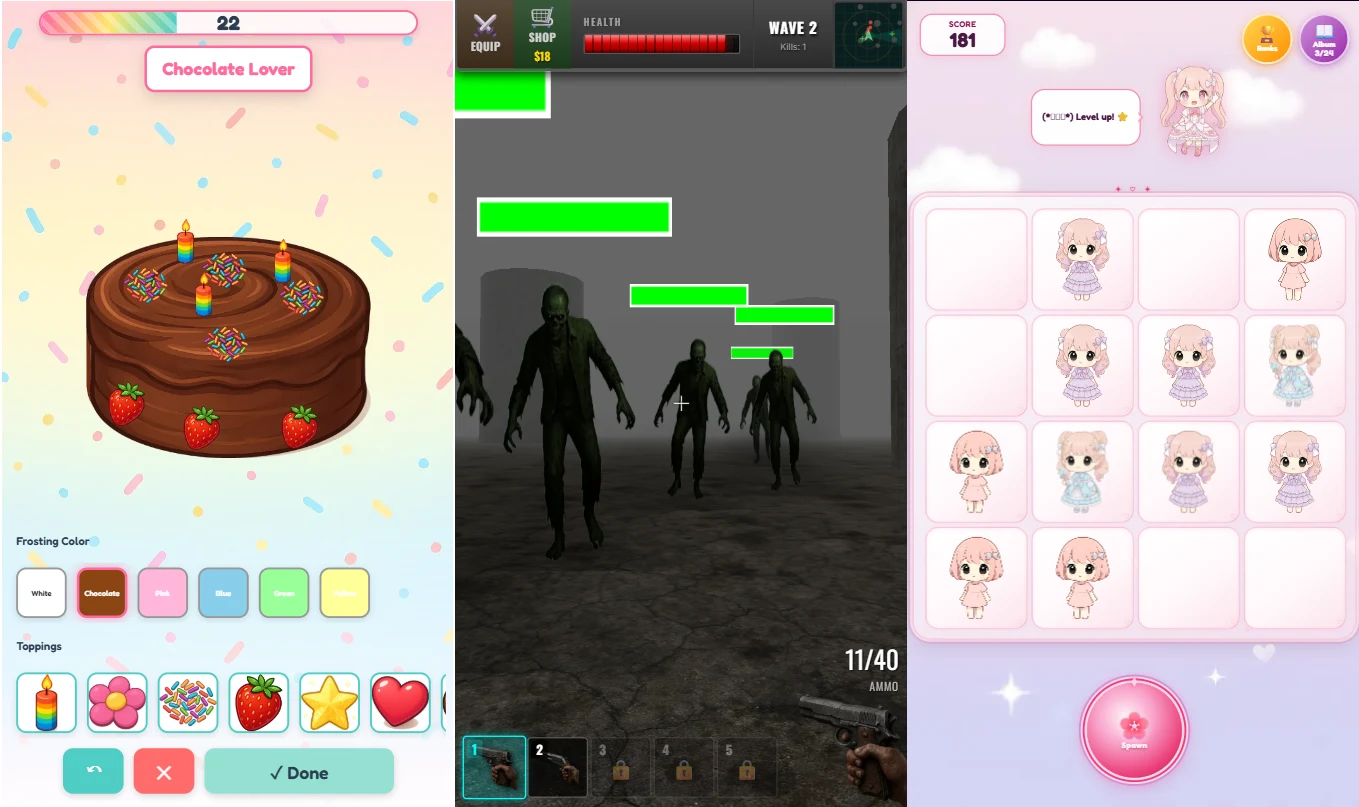
Erika: I focus a lot more now on the games I’m good at and the ones that are performing well, and I try to expand slowly into harder games instead of rushing. I used to remix a lot, which isn’t really the best approach. Now I mostly work from what we call “wishes” (Astrocade’s word for a prompt), and I keep a library of wishes I’ve used before. If I’m building a shooter, for example, I’ll go back to one of my own earlier shooter games and reuse the wish that handled the polish and feel well, rather than starting from zero each time.
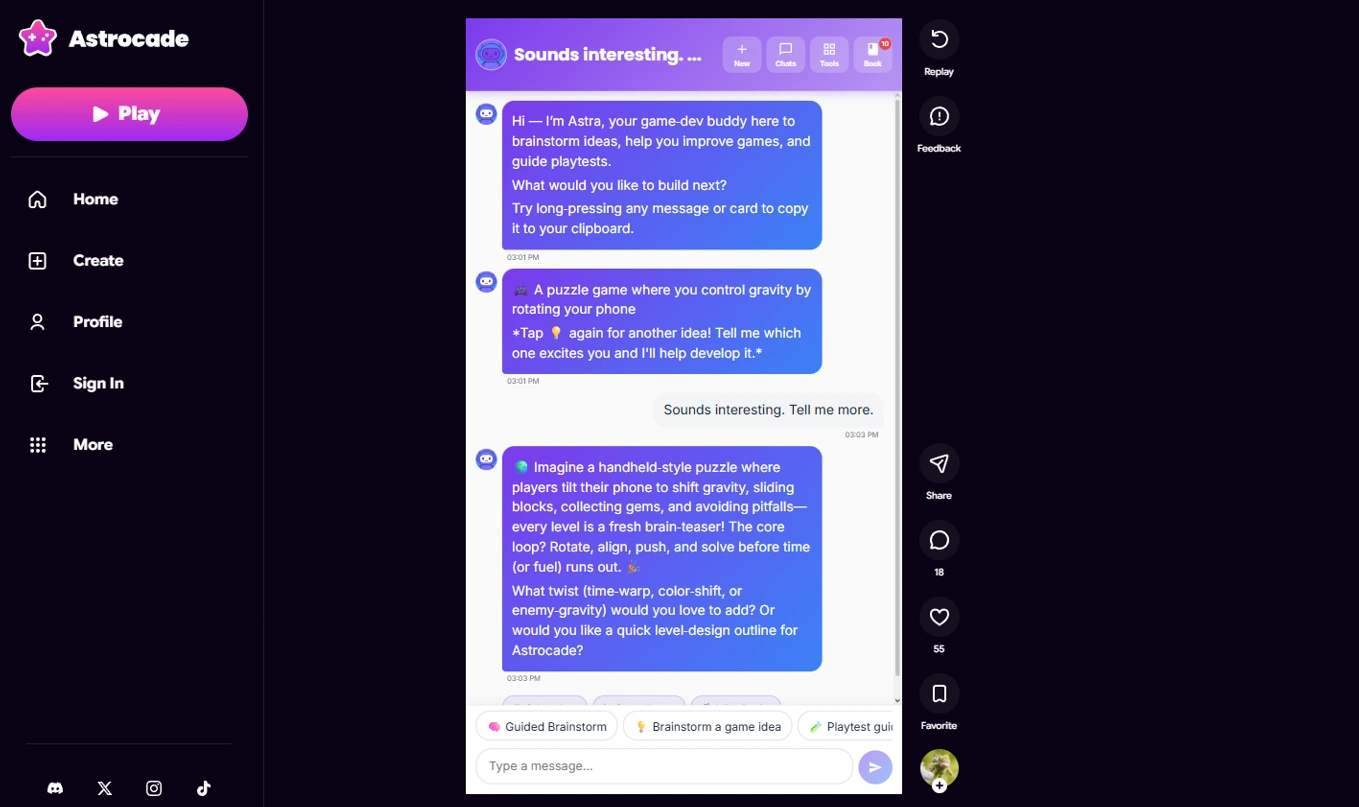
I even built a small chatbot on Astrocade: part project manager, part brainstorming tool. You can use it to come up with game ideas, generate prompts and characters, put together a game design document, keep track of your assets, even get marketing tips. It took me about seven hours to build. It’s not the most polished thing, but it’s been genuinely useful, both for me and for other creators I share it with.
Vibecode.game: What about your own workstation, are you building on a laptop, or something else?
Erika: Almost all of my games are made on my phone. I found ways to work around the limitations: for dress-up games, for example, I add sliders directly into the game so I can position assets myself instead of needing a desktop editor. I only switch to desktop for things like precise asset placement. Most of the time I’m just lying in bed, typing out what I want built.
Getting seen
Vibecode.game: One thing that jumps out scrolling through Astrocade is how much familiar IP shows up: Barbie, Pokémon, characters everyone already recognizes on sight. It’s the fastest way to borrow someone else’s built-in audience, but it’s also the shakiest ground to build a career on. What’s the actual situation there, including for you?
Erika: I’m actually trying to pivot away from that. It’s technically allowed in the terms of service, but the platform has started restricting it: sometimes the AI will just tell you it can’t make that type of game, or the output starts to distort the further you get into it. They also won’t run ads on known IP games. I didn’t want my whole catalog to be one thing, so I’ve been focusing more on original IP games, even though I’ve noticed those don’t always perform quite as well right out of the gate.
Vibecode.game: Every platform has its own black box, and creators spend half their time trying to reverse-engineer it from the outside. What actually decides which of your games gets seen?
Erika: There’s an analytics dashboard where you can see plays, significant plays, and (most importantly) median play duration. The longer people stay in your game, the better your chances of landing in Trending or, even better, Player’s Choice. Player’s Choice is the big one: once your game gets pulled into that list, growth can jump dramatically, sometimes tens of thousands of plays a day. But it drops off just as fast once you’re out of it. If people are dropping off in the first 10 or 30 seconds, that’s usually a sign something’s wrong: either performance or the core loop just isn’t landing.
Vibecode.game: Is there a creator you’d point to as a model for doing this well?
Erika: There’s one creator, Djam, who’s been on the platform since almost the start. He only has around a dozen published games, but nearly all of them are in the millions of plays. He spends two to four weeks per game instead of rushing, and almost everything he makes lands in Player’s Choice and stays there for months. He’s proof that quality over quantity really does work, even on a platform built for speed.
Making it pay
Vibecode.game: This is probably the question every skeptic asks first: can you actually make real money doing this, or is “creator economy” just a nice phrase platforms use to keep people making content for them for free? Walk me through how creators actually get paid.
Erika: Astrocade doesn’t run ads during the game itself: we get paid per view once a game hits enough “significant plays,” which is anyone who plays for 30 seconds or more. At 25K significant plays you qualify for the Ambassador Program and can start earning rewards if you rank on Player’s Choice. Once you cross 100K significant plays you’re invited into the Creator Program and start earning per play. Right now the bonus rate is 10 cents per thousand plays, with multipliers on top. There’s also a referral program: new creators get $25 for their first game once they post it, plus small bonuses at milestones. Referrers can earn up to $160 per referral. Then there are weekly game jams with a $500 prize pool, plus smaller giveaways.
Vibecode.game: What’s it actually added up to for you?
Erika: I hit a million plays in my first month, and it took me seven months to reach 30 million plays total. That put me among the fastest-growing creators on the platform. The exact revenue is a little hard to pin down since I wasn’t earning from all of it, but on average I make somewhere between $1,000 and $3,000 a month now. However, it’s subject to change. I don’t want people to join and get discouraged if their first games don’t take off right away. I try to help newer creators one at a time when I can, testing their games and giving feedback.
Parting words
Vibecode.game: We’ve covered the algorithm, the money, the workflow, but I’d guess what actually stops most people isn’t any of that, it’s just never hitting “go.” Any last piece of advice for someone still on the fence?
Erika: Just start showing up and keep building. You don’t need years of coding experience or a huge team: you need to keep learning and keep putting things out. Some of my most successful games came from ideas I almost didn’t take seriously. You won’t know what works until you try it.
Keep exploring
- Erika’s full catalog on Astrocade, where new games go up several times a week: astrocade.com/profile/erika
- Astro Academy: astrocade.com/create/academy
- How to earn on Astrocade: Ambassador & Creator Programs
- Apply to the Referral Program on the Astrocade Discord. Include Erika (@rika427) in your application for up to $160 in cash bonuses.