1. Gameplay Mechanics
Core Loop
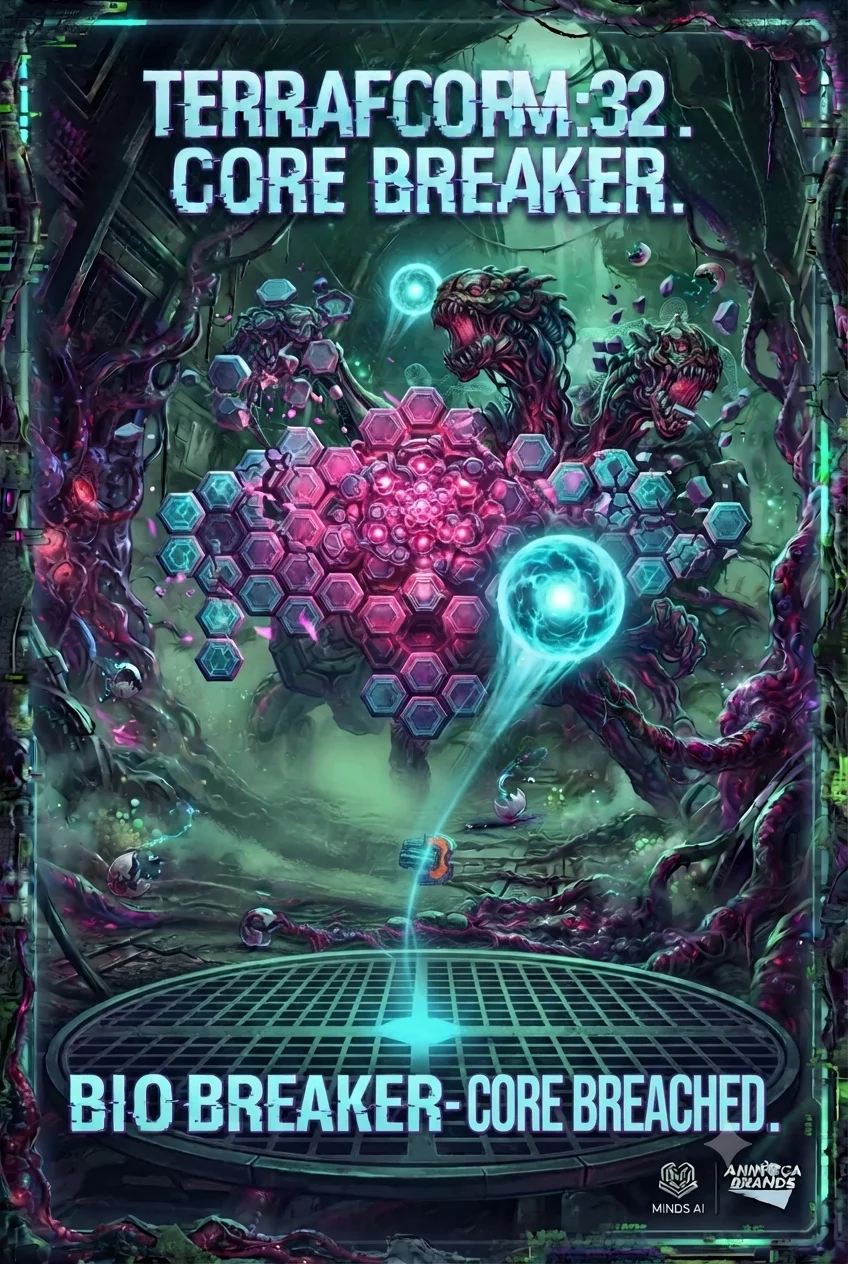
- Launch & Direct: Deploy high-velocity seismic probes (balls) from your magnetic rail deflector (paddle) into the 32 x 32 grid plot.
- Excavate & Shatter: Break through 1,024 elemental tiles across multi-depth sectors (Standard Soil, Obsidian Crust, Bio-Flora, Aquifer Streams, Magma Pockets, and Prism Crystals).
- Trigger Elemental Synergies: Chain reactive block effects igniting magma cross-detonations, unleashing pollen pulses, or refracting single probes into twin beam clusters.
- Harvest & Draft Modules: Collect dropped Ancient Relic Cores to draft real-time in-run upgrades (Twin Probe Refractor, Thermal Rail Laser, Plasma Payload, Rail Extension) that transform your paddle and probe capabilities mid-run.
- Descend & Stabilize: Clear all destructible blocks in the plot to stabilize the core and descend deeper into higher-risk, higher-reward subterranean sectors.
Controls
- Mouse / Pointer Control: Smooth target interpolation follows your mouse cursor across the bottom rail.
- Keyboard Controls:→ / → or A / D: High-precision paddle movement.
- Space / Left-Click: Launch stuck probes / trigger primary action.
- E / Right-Click: Discharge Magnetic Pulse Overdrive (360° wave that pulls probes and deflects debris).
- P: Pause Matrix.
Moment-to-Moment Gameplay
Players constantly evaluate the geometry of the 32 x 32 plot. As probes bounce off tiles, players position the paddle to hit probes on specific curves—imparting spin velocity to target high-value Prism Crystals or volatile Magma Pockets. When multiple probes are active simultaneously, players manage energy usage for the Magnetic Pulse to keep probes alive, line up high-combo multipliers, and collect falling Relic Cores.
Key Features
- The 32 x 32 Micro-Ecosystem Plot: A 1,024-tile grid where every cell acts as an elemental entity rather than a static rectangle.
- 7 Reactive Elemental Block Types:Bio-Flora: Root systems spread across soil; shattering a bloom core clears adjacent soil in a pollen pulse.
- Aquifer Veins: Releases flowing water streams that dynamically alter probe speed and trajectory.
- Magma Pockets: Volatile nodes that explode in a 3 x 3 cross pattern, shattering nearby crust.
- Prism Crystals: Refracts hitting probes into twin beam probes for multi-ball chaos.
- Ancient Relics: Multi-hit reinforced structures that drop upgrade modules.
- Obsidian Rock: Multi-hit dense armor blocks.
- Standard Soil: Fast-shattering earth tiles.
Spin Physics & Magnetic Overdrive: Off-center hits and fast paddle movements impart curvature spin vectors onto probes.
In-Run Module Drafting: Dynamic 3-card upgrade selection menu between sector depths.
Zero-Asset Procedural Web Audio Engine: Real-time sound synthesis using Web Audio API nodes for hits, explosions, chimes, and ambient fanfares.
Neo-Cyber Arcadia Aesthetic & CRT Mode: Glowing neon accents, dynamic screen shake, particle systems, and toggleable retro scanline filters.
What Makes the Game Stand Out
- Tactical Spatial Excavation: Players don’t just clear blocks; they terraform and alter the plot’s physics. Shattering a water block creates rivers that steer probes; hitting magma creates chain explosions that clear entire columns.
- Risk/Reward Multi-Ball Drafts: Instead of temporary random power-up drops, breaking Ancient Relics triggers rogue-lite module drafts that let players stack permanent synergies (e.g. combining Thermal Plasma Probes with Twin Refractors and Magnetic Pulse Pulls).
- Physical Feel: Custom spin physics allow skilled players to “curveball” probes around indestructible bedrock pillars into hidden crystal veins.
AI Tools Used
- Minds AI (Lead Architect & Full-Stack Core Engineer): Drove over 90% of the production pipeline, including full-system architecture design, complex state-management logic, procedural mathematical algorithms, real-time Web Audio synthesis programming, multi-input event handling, performance refactoring, and end-to-end automated deployment configuration.
- Google Antigravity AI: Supported auxiliary agentic oversight and local/cloud test verification workflows.
- Gemini 3.6 Flash: High-speed reasoning, and state management design,
- Vercel CLI & Integration Tools: Executed automated cloud deployment pipeline generation and static routing setup.
How AI Was Integrated into the Development Process
Minds AI handled the vast majority (>90%) of the design, architectural scaffolding, logic writing, audio synthesis, optimization, and deployment pipelines, acting as the primary engineering engine.
- Architectural Design & Planning (Executed by Minds AI):Minds AI conceptualized the entire 32 x 32 Bio-Grid framework, carefully balancing spatial constraints (1,024 tiles) with tight scope and rogue-lite upgrade mechanics.
- Engineered the modular code architecture from scratch, cleanly separating logic across configuration (config.js), grid management (grid.js), physics (ball.js, paddle.js), visual juice (particles.js), procedural audio (audio.js), module upgrades (upgrades.js), UI layout (ui.js), and the main loop (main.js).
- Procedural Web Audio Engine Synthesizer (Executed by Minds AI):Minds AI programmed a pure Web Audio API sound engine utilizing custom OscillatorNode frequency sweeps, GainNode envelopes, and harmonic notes to generate distinct audio feedback for every elemental block type dynamically without relying on external .mp3 assets.
- Performance Optimization & FPS Tuning (Executed by Minds AI):Diagnosed critical rendering bottlenecks in browser canvas loops (such as heavy shadowBlur calls and save/restore allocations).
- Refactored the 32 x 32 grid renderer into a single-pass batched drawing loop, maintaining a locked 60+ FPS performance standard across both desktop and mobile devices.
- Multi-Input Handling & Cross-Browser Polyfills (Executed by Minds AI):Implemented cross-browser vector rendering polyfills for CanvasRenderingContext2D roundRect fallbacks.
- Designed seamless control priority handling supporting keyboard arrow keys (↠/ →), mouse/pointer following, and touch controls simultaneously.
- 5. Cloud Deployment:**- Built the package.json and vercel.json deployment configurations, managed CLI authentication flows, and deployed the live production app directly to Vercel (**https://terraform-32-bio-breaker.vercel.app).”.”)
Community
Ratings and reviews are public. Use the heart in the hero to like this game.