Screenshots
Game Trailer
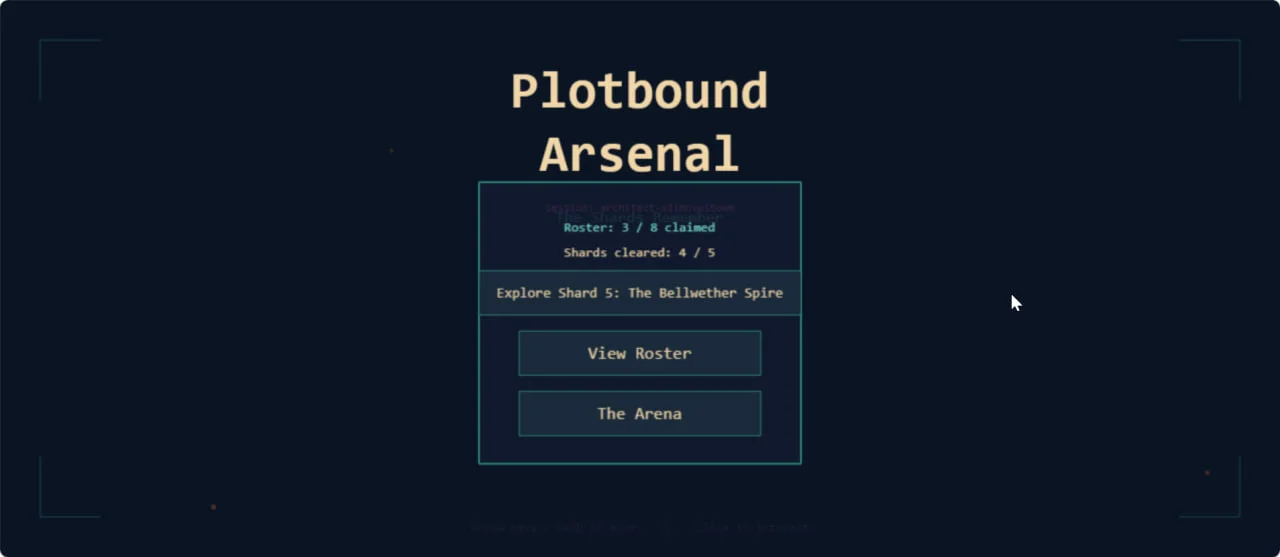
Plotbound Arsenal
The Shards Remember
A top-down exploration action-RPG where every creature you defeat becomes a creature you command.
After the Great Fragmentation, the world broke apart. What remains are shards — islands of land suspended above an endless storm
sea, each one sealed by a guardian that refuses to let go. You are an Architect: the last discipline of survivor able to walk
between shards, clear what lives there, and bind its guardian to your roster.
Five shards. Eight creatures. One rule — you only own what you can survive.
Core Loop
Plotbound Arsenal runs on a deliberately tight loop that teaches itself in under a minute and keeps escalating for the rest of the
run:
Explore a procedurally generated shard → clear the hostile creatures scattered across it → break the seal on the guardian → defeat
it → claim it permanently → carry it into the next shard.
Every shard is generated fresh from a seed. The terrain, the creature roster, the guardian’s corner, and the routes between them
are never the same twice — but the difficulty curve underneath is hand-tuned, not random.
Gameplay Mechanics
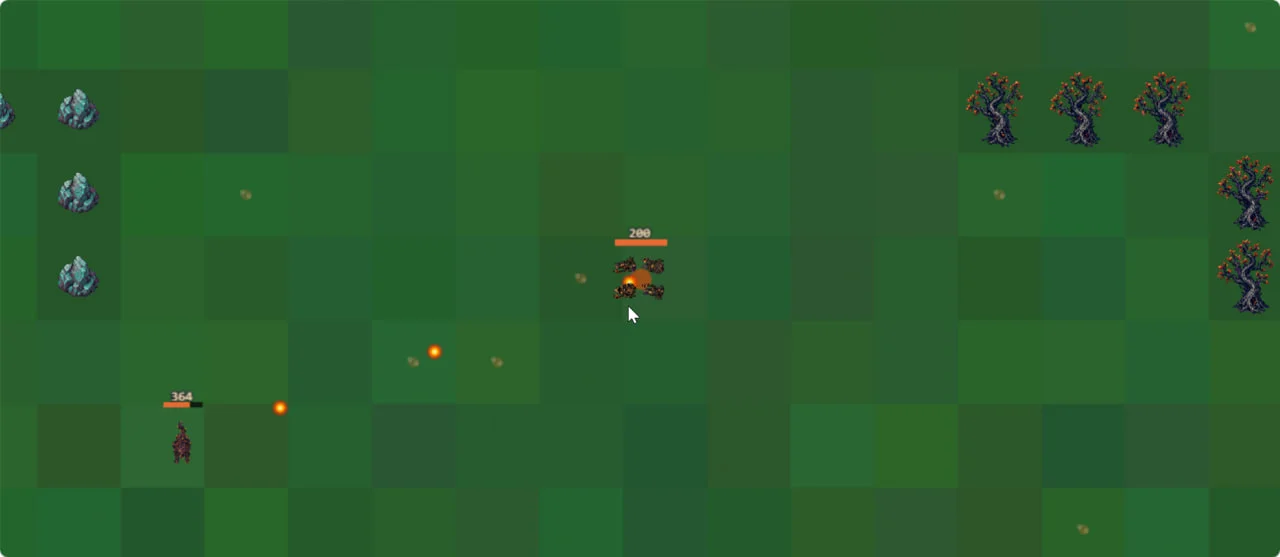
Auto-targeting combat with manual override. Your Architect acquires the nearest hostile within 400 units and fires automatically on
a 300ms cadence — so the moment-to-moment skill isn’t aiming, it’s positioning. Space bar gives you a manual burst when you need
to force a shot. Every projectile is a real simulated entity with travel time, a 2.5-second lifetime, terrain collision, and
radius-based impact resolution. Trees and rocks eat bullets. Cover is real.
A guardian gate that restructures the whole level. Each shard’s guardian sits behind a visible ember barrier at a random corner,
dimmed to a silhouette and completely untouchable. It cannot be rushed, cheesed, or skipped. Clear every last roaming creature and
the barrier detonates outward — THE GUARDIAN AWAKENS — and the shard turns from an exploration space into a boss arena. One level
design, two entirely different games.
Enemies that behave, not just chase. Roaming creatures track you between 80 and 200 units, hold their spacing instead of clumping
into your hitbox, and drift on sine-wave patrol paths when you’re out of range. Guardians don’t chase at all — they’re stationary
artillery with wider range, double the fire rate, and multi-shot spread volleys that fan 2 projectiles at Rare tier and 3 at
Legendary. Fighting one is a dodge problem, not a damage race.
Procedural generation with authored intent. A seeded generator lays down a water border, clusters trees and rocks, carves a
sine-curved path across the shard, and guarantees a safe clearing at your spawn point. Creature placement uses rejection sampling
with a minimum-separation constraint — up to 50 attempts per spawn — so you never get an unwinnable wall of enemies stacked on one
tile, and never a dead empty shard.
Difficulty that scales on seven independent axes. Every shard is a 32×32 tile world — roughly a thousand tiles of terrain per run. Across the five shards, enemy HP scales 1.8× → 4.5×, enemy power 1.3× → 2.6×, fire intervals tighten 1600ms → 850ms, and projectile speed climbs 200 → 280.
Guardians scale harder still: 3× → 9× HP, 1.5× → 3.5× power, and a fire rate that halves from 800ms to 400ms. The guardian tier
itself escalates from Rare to Legendary. By The Bellwether Spire, the same inputs that carried you through The Verdant Edge will
get you killed.
Permanent collection, permanent consequence. Defeating a guardian claims that creature into your roster forever and unlocks the
next shard. Progress persists to local storage under an anonymous auto-generated Architect ID — no login, no wallet, no signup
wall. A judge or a player is in the game in one click.
The Arena. Stake a claimed creature against a randomly drawn opponent from the wider bestiary, in a bounded combat space with
faster movement and its own AI phase system — approach, retreat, circle. Your collection isn’t a trophy shelf. It’s an army you can
field.
The Bestiary
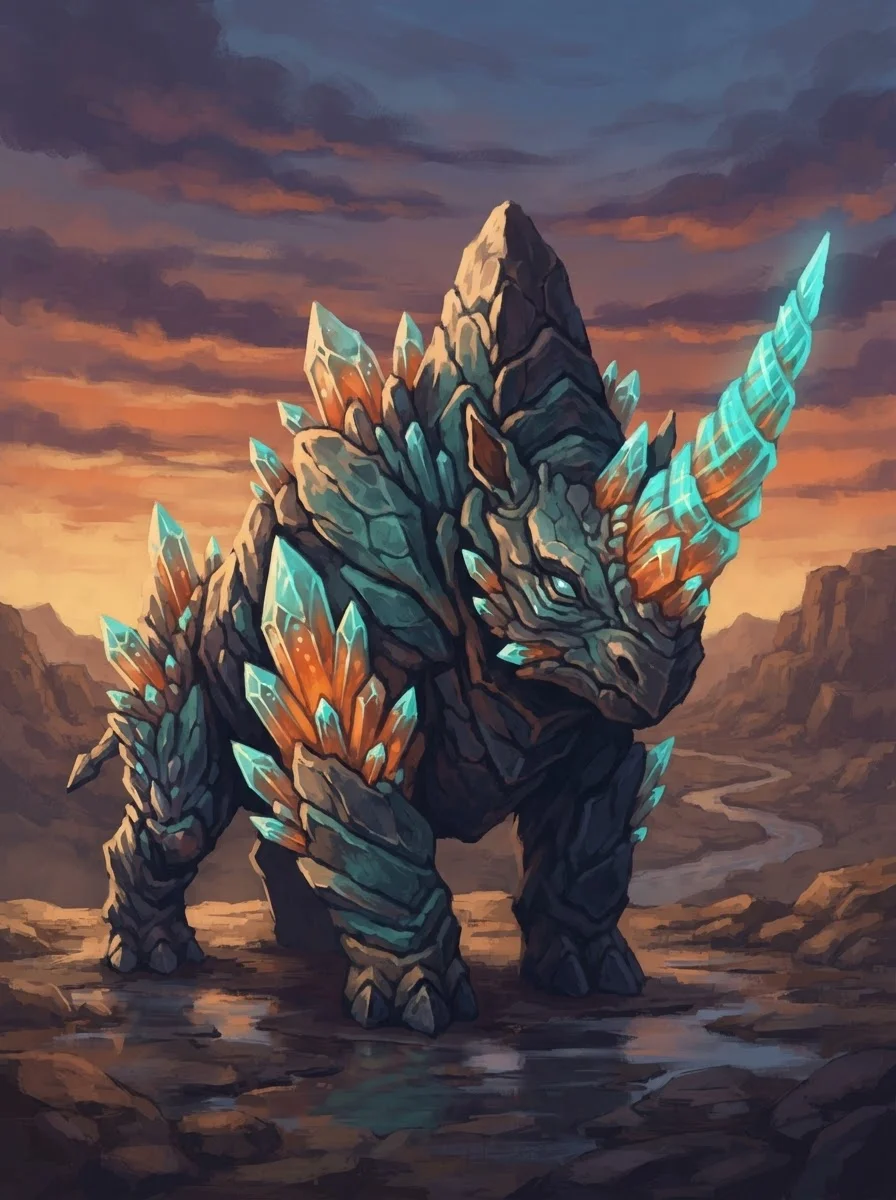
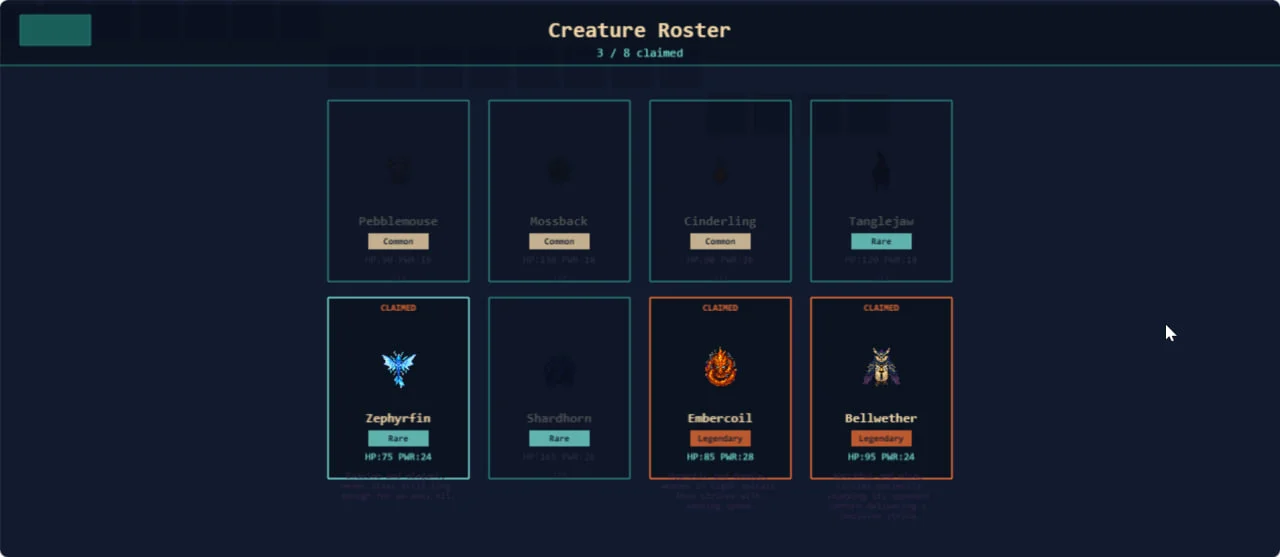
Eight creatures across three rarity tiers, each with distinct stats, silhouette, and a written behavioural identity:
- Common — Pebblemouse (timid, darts and retreats), Mossback (absorbs punishment, counters heavy), Cinderling (fragile, ferocious,
burns fast)
- Rare — Tanglejaw (prowls the perimeter, then lunges), Zephyrfin (evasive, never still), Shardhorn (charges straight through
anything)
- Legendary — Embercoil (hypnotic spirals, searing strikes), Bellwether (the owl-sentinel who studies you before it decides)
What Sets It Apart
It solves the genre’s oldest tension. Survivors-likes are frictionless but disposable — nothing carries forward.
Creature-collectors are meaningful but slow — menus, turns, waiting. Plotbound Arsenal takes real-time action from one and
permanent, earned ownership from the other. You don’t catch creatures. You beat them, and then they’re yours.
The guardian gate is genuinely novel level design. Most top-down action games separate exploration maps from boss rooms. Here
they’re the same physical space, and your own progress is what transforms it. The shard you spent three minutes learning becomes
the arena you have to survive in.
True desktop-and-mobile parity, not a mobile port. Keyboard and touch feed the same movement vector — one code path, no drift
between platforms. On touch, there’s no fixed joystick eating screen space: press anywhere, and that point becomes your stick, with
a sticky origin so direction reversals respond instantly and analog magnitude that’s speed-capped to exactly match keyboard input.
Neither control scheme has an advantage over the other.
No onboarding tax. Anonymous session, instant start, five distinct shards of content, and a readable HUD. Judges can evaluate the
actual game in the first fifteen seconds instead of fighting a wallet connect.
How AI Was Integrated Into Development
Minds AI by Animoca Brands was the creative foundation of this project. Every creature in Plotbound Arsenal — the full
eight-creature bestiary from Pebblemouse to Bellwether — along with the player Architect character and the world’s visual assets,
was generated with Minds AI. It didn’t decorate an existing game; it produced the cast the entire game was then designed around.
The rarity tiers, the stat spreads, the guardian escalation, and the shard themes were all authored in response to what Minds AI
created. Shardhorn’s crystal armour is why Crystal Archipelago is choked with rock formations. Bellwether’s owl-sentinel silhouette
is why the final shard is called The Bellwether Spire. The creatures came first, and the game grew out of them.
Verse8 then took that generated output and made it real inside a running game — handling the asset pipeline, hosting, and delivery
so that Minds AI’s creatures could be loaded, scaled, and animated as live sprites in the engine rather than sitting as flat
concept art.
Claude Fable 5 refined the layer on top: translating each Minds AI creature into balanced gameplay data — HP, power, hitbox size,
behavioural personality — and building the systems that let them act. Procedural world generation, projectile simulation, the
guardian barrier state machine, enemy AI phases, and the unified keyboard-plus-touch input layer were developed and hardened with
Fable 5, including a full behavioural test suite covering the control system.
The pipeline was deliberate: Minds AI created the world’s inhabitants. Verse8 delivered them into the engine. Claude Fable 5 gave
them rules to live by.
Built With
Phaser 3.90 (Arcade Physics) · TypeScript · React shell · Vite · Tailwind CSS · WebGL with automatic Canvas fallback · responsive
scaling · localStorage persistence · deployed on Vercel
Community
Ratings and reviews are public. Use the heart in the hero to like this game.